
Description
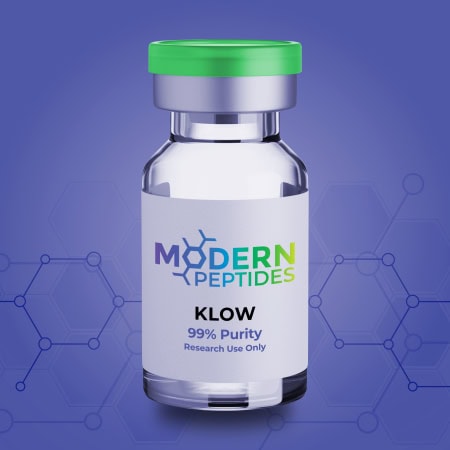
Ultimate Tissue Repair: Buy the KLOW Blend – BPC-157 | TB-500 | GHK-Cu | KPV))
The KLOW Blend is a powerhouse multi-peptide formulation designed for advanced laboratory research. By combining four of the most studied peptides—BPC-157, TB-500, GHK-Cu, and KPV—this blend offers a synergistic approach to investigating tissue regeneration, cellular repair, and inflammatory pathways.
Why the KLOW Blend Outperforms Single Peptides
When you are dealing with stubborn joint pain, torn connective tissue, or systemic flare-ups, a single peptide often only addresses one piece of the puzzle. The KLOW Blend acts as a full-scale biological construction crew.
Here is exactly how these four powerhouses work together:
| Peptide | Core Function | How It Contributes to the Blend |
| BPC-157 (Body Protection Compound) | Localized healing & gastric support | Upregulates growth hormone receptors in fibroblasts to rapidly repair tendons, ligaments, and gut lining. |
| TB-500 (Thymosin Beta-4 Analog) | Systemic cell migration & flexibility | Promotes actin polymerization and angiogenesis (new blood vessel growth) to speed up muscle and tissue recovery across the whole body. |
| GHK-Cu (Copper Peptide) | Collagen synthesis & matrix remodeling | Builds the extracellular matrix—the actual “scaffolding” your skin and connective tissues need to rebuild smoothly and minimize scarring. |
| KPV (Lysine-Proline-Valine) | Potent anti-inflammatory | A master peptide that calms overactive immune responses and downregulates inflammatory cytokines, clearing the path for healing. |
Key Benefits of Klow Blend BPC-157 | TB-500 | GHK-Cu | KPV
Whether you are conducting laboratory research or optimizing systemic wellness under clinical guidance, the KLOW matrix targets several distinct biological pathways:
-
Accelerated Soft-Tissue Repair: Speeds up the recovery timeline for stubborn muscle tears, sprains, and ligament issues.
-
Advanced Inflammation Management: KPV and BPC-157 work in tandem to calm localized and systemic inflammatory loops without suppressing your body’s natural immune efficiency.
-
Connective Tissue & Skin Rejuvenation: The heavy presence of GHK-Cu triggers intense collagen production, reinforcing joint elasticity and improving skin density.
-
Enhanced Tissue Remodeling: Helps the body repair tissue correctly, preventing the messy, rigid scar tissue formations that often cause chronic, long-term stiffness.
The Science Behind the KLOW Blend Components
Each peptide in the KLOW formulation targets a distinct biological pathway, creating a comprehensive platform for regenerative studies.
1. BPC-157 (Body Protection Compound)
Derived from human gastric juice, BPC-157 is renowned in the research community for its potent healing properties. It is primarily studied for:
-
Angiogenesis: Promoting the formation of new blood vessels.
-
Soft Tissue Repair: Accelerating the healing of tendons, ligaments, and muscles.
-
Gastroprotective Effects: Investigating the repair of the gut lining.
2. TB-500 (Thymosin Beta-4)
TB-500 is a synthetic version of a naturally occurring peptide found in almost all human and animal cells. In research settings, its primary role involves:
-
Actin Regulation: Essential for cell migration and wound healing.
-
Inflammation Reduction: Assisting in the recovery of damaged tissues.
-
Flexibility & Joint Health: Studying the regeneration of connective tissues.
3. GHK-Cu (Copper Peptide)
GHK-Cu is a naturally occurring copper complex that plays a vital role in skin and tissue health. Research focuses on:
-
Collagen Synthesis: Stimulating the production of collagen and elastin.
-
Skin Remodeling: Investigating its potential to reverse aging and repair scars.
-
Antioxidant Properties: Protecting cells from oxidative stress.
4. KPV (Lysine-Proline-Valine)
KPV is a C-terminal peptide fragment of alpha-melanocyte-stimulating hormone It is highly regarded for:
-
Anti-Inflammatory Action: Modulating the immune response at the cellular level.
-
Antimicrobial Properties: Investigating its effectiveness against various pathogens.
-
Gut Health: Researching its role in treating inflammatory bowel conditions.
Synergy in Research: Why the KLOW Blend?
The KLOW Blend (typically provided as an 80mg lyophilized powder) is designed to maximize research efficiency. Rather than studying these compounds in isolation, researchers can observe how they interact:
-
Repair & Rebuild: BPC-157 and TB-500 work together to drive the mechanical repair of tissues.
-
Structural Integrity: GHK-Cu provides the building blocks for remodeling the extracellular matrix.
-
Inflammatory Control: KPV ensures the environment remains conducive to healing by managing overactive immune responses.
Technical Specifications
-
Purity: 99% HPLC tested.
-
Form: Lyophilized powder for stability.
-
Storage: Recommended refrigerated storage at 2°C to 8°C after reconstitution.
Research Disclaimer: KLOW Blend is intended for laboratory research use only. It is not intended for human or veterinary use. Always adhere to local regulations and safety protocols when handling research peptides.
Stability and Purity Matter
There is a common myth in the peptide community that mixing complex peptides like GHK-Cu with BPC-157 in a single vial causes them to degrade or chemically collapse.
We don’t guess; we test. High-resolution chromatography testing proves that when properly lyophilized (freeze-dried) and stored under correct refrigerated conditions, the KLOW Blend maintains its 99%+ purity and molecular integrity without premature breakdown.
When you buy the KLOW Blend, you are getting an exact, stable ratio of premium, high-purity compounds designed for maximum stability.
The Definitive Proof on Mixing Peptides
This video provides lab-tested data on the stability and purity of peptide blends like KLOW, debunking common myths about peptide degradation when mixed in a single vial.
Frequently Asked Questions (FAQ)
How should the KLOW Blend be stored?
Like all high-purity lyophilized peptides, the KLOW Blend should be kept in a cool, dark place. For long-term stability before reconstitution, store the vial in the refrigerator. Avoid exposing the vial to direct sunlight or extreme temperature swings.
What is the typical cycle length for this blend?
In most clinical and research protocols, multi-peptide recovery stacks are run in cycles rather than continuously. A standard cycle often lasts between 4 to 8 weeks, followed by a dedicated rest period (typically 2 to 4 weeks) to allow cellular receptors to reset.
Is GHK-Cu supposed to look blue?
Yes! GHK-Cu is a copper peptide, which naturally gives the lyophilized powder a distinct, light blue or teal tint. This is completely normal and a visual hallmark of high-quality copper binding.
Ready to Elevate Your Protocol?
Stop buying separate vials and managing messy, inaccurate dosing schedules. Secure the ultimate hyper-recovery matrix today.
Reviews
There are no reviews yet.