
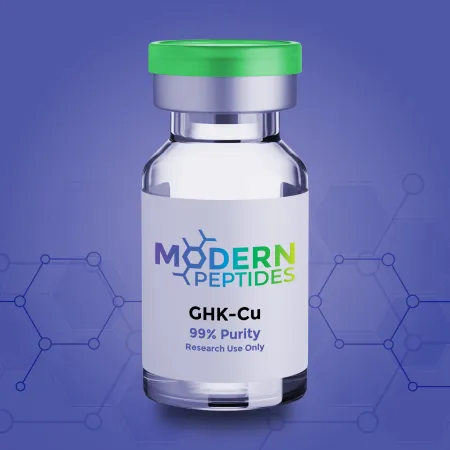
Description
The Biohacker’s Guide to Buying GHK-Cu: What Science Actually Says About the “Blue Peptide”
GHK-Cu is a naturally occurring copper complex first discovered in human plasma in 1973. Often called the “blue peptide” due to its distinct cobalt hue, it has gained a massive following for its ability to literally “reset” genes to a younger state.
Often called the “fountain of youth” molecule by health optimization communities, this copper peptide has transcended standard beauty counter trends. It has firmly established itself as a heavyweight in cellular tissue repair and anti-aging.
But if you are ready to buy GHK-Cu, navigating the marketplace can feel like a minefield of scientific jargon, varying purity grades, and competing delivery methods. Let’s break down exactly what it is, how it works, and how to safely choose a high-quality product that aligns with your health goals.
What is GHK-Cu (And Why Is Everyone Talking About It)?
GHK-Cu is a naturally occurring copper peptide complex consisting of glycyl-L-histidyl-L-lysine (a tiny chain of three amino acids) bound to a copper ion.
Discovered in 1973 by Dr. Loren Pickart, this tiny molecule acts as a critical signal flare in the human body. When your tissues experience stress or injury, this peptide rushes to the site to downregulate inflammation and command your cells to start rebuilding.
The catch? Our bodies produce less of it as we age. By the time we reach age 60, our native GHK-Cu levels drop by more than 60%. This steep decline is a massive reason why our skin thins, our hair loses its density, and our bodies take longer to bounce back from injury as the years go on.
Why Buy GHK-Cu?: What the Research Shows
When you add GHK-Cu back into your system, you are essentially restoring your body’s youthful repair signals. Large-scale genomic research indicates that it can modulate thousands of human genes—turning up the dials on cellular regeneration and dampening chronic inflammatory pathways.
The most widely documented benefits include:
-
Deep Collagen and Elastin Synthesis: Unlike raw collagen molecules (which are too large to actually absorb through the skin barrier), GHK-Cu provides the micro-building blocks that signal your fibroblasts to ramp up native production of Collagen I, Collagen III, and elastin.
-
Accelerated Skin Recovery: Clinical trials show that this product significantly speeds up skin re-epithelialization (barrier restoration) after aggressive aesthetic treatments like microneedling, chemical peels, and laser resurfacing.
-
Follicle Revitalization: In scalp care, GHK-Cu works by local vasodilation (widening blood vessels) and stimulating growth factors. This extends the anagen (active growth) phase of hair, protecting follicles from premature shrinking.
-
Systemic Connective Tissue Support: Emerging pre-clinical research suggests its tissue-remodeling properties extend far beyond the surface, supporting bone matrix, lung tissue, and overall gut lining integrity.
Topical vs. Injectable: Which Route is Right for You?
When looking to buy GHK-Cu, you will primarily encounter two formats. Choosing the right one depends entirely on your target goals and comfort level.
| Delivery Method | Best Used For | Typical Timeline | What to Look For |
| Topical (Serums/Creams) | Daily facial anti-aging, targeting fine lines, hyperpigmentation, and daily scalp/hair thickness maintenance. | Gradual, compounding changes over 4–8 weeks. | Look for an optimal cosmetic concentration of 1% to 2% GHK-Cu. Ensure it has a distinct copper-blue tint. |
| Injectable (Subcutaneous) | Deep tissue remodeling, systemic injury recovery support, and rapid, full-body anti-aging protocols. | Faster onset; subtle physiological changes in 2–4 weeks. | Requires access through a licensed telemedicine provider or compounding pharmacy. |
3 Critical Rules to Follow Before You Buy GHK-Cu
Because the market for peptides is rapidly expanding, quality control varies wildly. Keep these guardrails top-of-mind before making a purchase.
1. Look for the “True Blue” Color
GHK-Cu is inherently a rich, royal sapphire blue color due to the copper binding to the peptide. If you buy a topical serum or a reconstituted vial that arrives completely clear, milky white, or yellowish, it either contains virtually zero copper peptide or is an entirely different formulation.
3. Check for Ingredient Synergies
For topical skin care, GHK-Cu works beautifully when paired with hydrating vehicles like Hyaluronic Acid, Niacinamide, or natural barrier-mimicking lipids like Tallow. However, avoid layering it in the exact same application window as high-percentage Vitamin C or strong Alpha Hydroxy Acids (AHAs), as highly acidic environments can break down the peptide bond and cause the copper to oxidize
A Note on Safety: While topical GHK-Cu cosmetics are widely available over the counter, systemic or injectable peptide therapies should always be approached under the guidance of a healthcare professional. Always consult a qualified provider to establish an appropriate personalized protocol for your body.
Can I order from Florida peptides safely?
Yes you should be confident to order from us because we don’t just offer you great products we top it by making sure your products get to you safely, & correctly. We ship within the US and our products are shipped in protective plastic clamshells inside a quality product box that is sealed for protection. The box is placed into a fitted bubble sleeve that is sealed and finally packaged safely into crush-proof B-fluted cardboard box mailers. we are confident your order will arrive in the best condition possible and can always rely on a good experience with us.
How to Use GHK-Cu Safely
To get the most out of GHK-Cu without irritation (sometimes called “copper uglies” if overused), follow these guidelines:
-
Avoid Mixing with Vitamin C: High concentrations of L-ascorbic acid can break down the copper peptide. Use them at different times of day (e.g., Vitamin C in the morning, GHK-Cu at night).
-
Optimal pH: GHK-Cu is most stable between pH 5.0 and 7.0.
-
Concentration: For DIY serums, an effective concentration is typically 0.05% to 0.1% of the pure peptide.
Whether you’re looking to tighten sagging skin or support your body’s internal repair mechanisms, GHK-Cu is one of the most scientifically backed peptides available. Its ability to modulate genes makes it more than just a cosmetic fix—it’s a tool for biological optimization.
Reviews
There are no reviews yet.